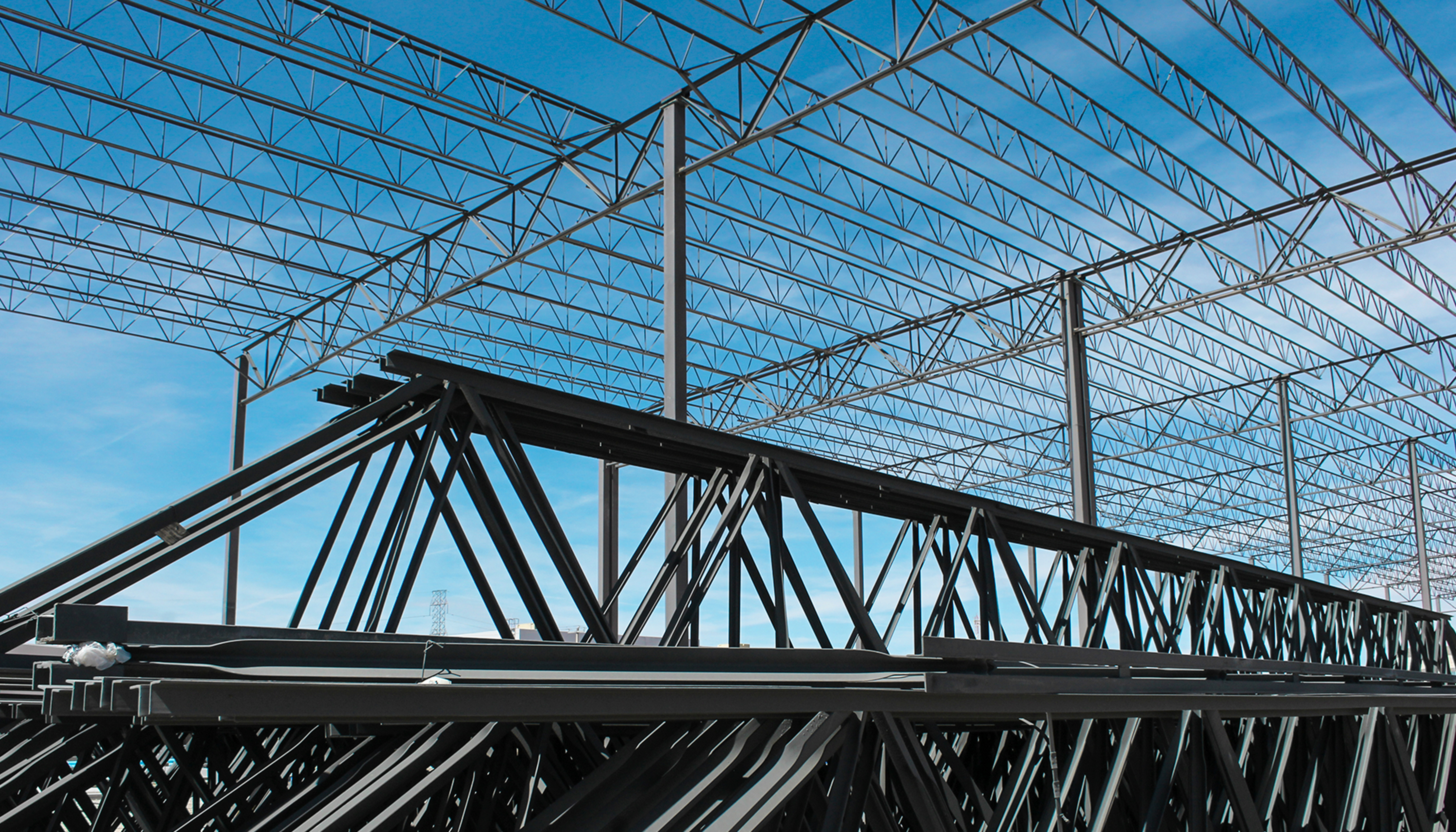
Steel joists are used on thousands of projects every year, but welding steel joists is still widely misunderstood. Some of that confusion comes from the overlap between Steel Joist Institute requirements and American Welding Society codes. Some comes from not fully understanding the difference between welding performed during joist manufacturing and welding performed in the field.
That distinction matters.
Welding in a joist plant is highly repetitive, controlled, and backed by established procedures, testing, and inspection. Field welding is different. It happens under real jobsite conditions and directly affects both construction-phase stability and long-term structural performance. Understanding both sides of the equation helps engineers, specifiers, inspectors, and contractors make better decisions.
This article breaks down how steel joists are welded, the common types of welded joints found in joist construction, the welding processes used in manufacturing, the most important field welding considerations, and how today’s SJI welding criteria relate to AWS requirements.
Common Welded Joints In Steel Joists
Understanding the types of welded joints is the foundation of understanding joist performance.
Chord Splices
Joist chords are usually angle sections that are cut and or butt-spliced to achieve the required length. Even when the joist is shorter than a standard stock length, continuous-feed manufacturing can still result in splices as part of efficient material usage. Angle sizes can range from 1 inch by 1 inch by 7/64 inch up to 6 inches by 6 inches by 3/4 inch and larger. Some manufacturers also use cold-formed angle chords fed from coil and spliced while flat before cold-forming.
In practice, that means chord splices are a normal part of joist production, not an exception.
Temporary Welds And Tack Welds
Before joists are moved to the welding area, they must be held together at the rigging table or jig. Clamps are used where feasible. Where they are not feasible, tack welds hold the joist together until full welding is completed.
Some tack welds may later be incorporated into the final design weld, and some may not. If a tack weld is incorporated into the design weld, it must meet all design weld requirements.
Web-To-Chord Joint Welds
The main finish or joint welds in joists are web-to-chord welds. Their minimum size and length are controlled by a combination of manufacturer standards and design requirements on the manufacturing shop order. The three primary web member types used in steel joists are round bars, single members, and double members.
Round Bar Web Members
Round bars are typically bent into continuous V or W patterns. They are more common in shallower joists and less efficient for deeper joists. These members are welded on one side of the bar to each chord angle using flare-bevel-groove welds.
Single-Member Web Systems
Single members sit inside the chord gap and can include crimped angles, rotated single angles, formed U or C shapes, and cold-formed channel sections. These members often use a combination of fillet welds and flare-bevel-groove welds, though they are typically designed conservatively as fillet welds. They are usually welded along one side to each chord angle, with a return weld across the end.
Double-Member Web Systems
Double members are placed outside the vertical legs of the chord angles. They are typically welded across both toe and heel at the ends. The SJI specification does not require balanced welds for these members. In some cases, full-thickness fillet welds may be used on thicker materials, and the members are often tied together at mid-length with a batten.
Welding Processes Used In Joist Manufacturing
Modern joist manufacturing relies on several welding processes, each suited to specific applications.
Shielded Metal Arc Welding (SMAW)
Also known as stick welding, SMAW uses solid-core electrodes surrounded by flux shielding material. It is commonly used for temporary tack welds during assembly.
Flux Cored Arc Welding (FCAW)
FCAW uses a tubular electrode with flux inside the core. It supports a range of wire diameters and is commonly used in production environments requiring flexibility.
Gas Metal Arc Welding (GMAW)
GMAW, or MIG welding, uses shielding gas instead of flux and produces a slag-free weld pool. GMAW is the most commonly used welding method in joist manufacturing due to its efficiency and consistency.
Resistance Welding
Resistance welding joins materials through pressure and heat generated by electrical current. Common methods include resistance spot welding, flash welding, and upset welding, with flash welding often used for butt splices.
Quality Control In Joist Welding
Given the volume of welds produced in joist manufacturing, quality control is critical. Methods may include visual inspection, non-destructive testing such as pry loading, full-scale load testing, destructive testing, and cross-sectional analysis of welded joints.
This level of testing ensures consistency, reliability, and long-term performance across millions of welds.
Field Welding On Steel Joists
Field welding plays a critical role in both safety and performance. The welding executed in the field directly impacts the stability of joists during construction and their long-term behavior in service. Proper technique and inspection are essential.
Field welding must comply with AWS D1.1 for structural steel and AWS D1.3 for sheet steel. Electrodes must meet AWS specifications and be properly stored. Inspection is limited to field welds and must be performed by qualified personnel.
The three primary areas of field welding are joist end anchorage, joist bridging, and metal decking.
Joist End Anchorage
In most cases, standard SJI end anchorage welds are sufficient. However, additional attention is required when joists are subject to uplift, axial forces, or rigid frame conditions. In these situations, larger or longer welds may be needed.
For uplift conditions, bolted connections typically provide the primary resistance, while welds contribute to lateral stability. If bolts are omitted, equivalent welds may be used if approved and properly detailed.
Joist Bridging
Joist bridging stabilizes joists during construction and is essential for worker safety and structural performance. Welded connections for bridging must resist anticipated forces, meet SJI specifications, and be executed as fillet welds. Spot or tack welds are not acceptable for this purpose.
Metal Decking
Metal deck welding must comply with AWS D1.3 and Steel Deck Institute requirements. Welds must fully penetrate deck layers and properly fuse to supporting members. Fillet welds must be at least 1½ inches long.
Special care is required when welding deck to K-Series joists due to thinner top chords. Melt-through is a known risk and must be reported to the joist manufacturer if it occurs.
Understanding SJI And AWS Welding Criteria
Modern SJI specifications require compliance with AWS welding standards, with clearly defined exceptions tailored to joist manufacturing. These modifications account for the repetitive nature of joist welding and its proven performance history.
Key allowances include limited undercut in specific orientations, acceptance of minor discontinuities outside design weld lengths, and defined treatment of tack welds. These criteria are designed to maintain structural performance while recognizing the realities of joist fabrication.
What This Means For Engineers, Inspectors, And Contractors
Welding steel joists requires understanding both controlled manufacturing processes and variable field conditions. Shop welding benefits from repetition, testing, and standardization. Field welding requires careful execution because it directly impacts stability and safety.
For specifying professionals, this means evaluating special conditions such as uplift, unsupported chords, and axial loads. For inspectors, it means recognizing where SJI criteria differ from standard AWS expectations. For contractors, it means executing field welds correctly, particularly at critical connections like bridging and decking.
Welding Steel Joists With Confidence
Welding plays a critical role in the performance of steel joists, both in controlled manufacturing environments and in the field. Understanding how welding steel joists works, from common joint types and welding processes to field requirements and inspection criteria, helps engineers, contractors, and inspectors ensure structural integrity, jobsite safety, and long-term reliability. The right approach is one that recognizes the strengths of standardized shop welding while applying careful attention to field conditions where performance matters most.
If you need guidance in understanding welding requirements, evaluating joist details, or sourcing high-quality steel joists for your next project, contact us today. Our team can help you navigate specifications, coordinate with project requirements, and keep your design moving forward with confidence.