When architects and designers begin shaping a structural system, one of the early decisions involves how the building will span. This steel joists vs steel beams comparison explores how each system performs across design flexibility, cost, installation, foundation impact, and sustainability.
Understanding how they compare in design flexibility, cost, installation, foundation impact, and sustainability can help project teams make more informed decisions early in schematic design.
This guide breaks down how steel joists compare to steel beams across design flexibility, cost, installation, foundation impact, and sustainability to help you select the right approach.
Quick definitions
Before diving deeper into steel joists vs steel beams, it helps to understand how each structural member functions within a building frame.
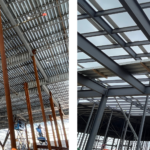
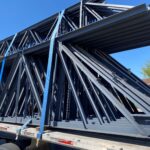
Steel joists (often open-web joists) are lightweight, triangulated members typically used to support floor or roof decks over longer spans with reduced weight. They are commonly paired with steel joist girders or wide-flange beams that collect joist reactions.
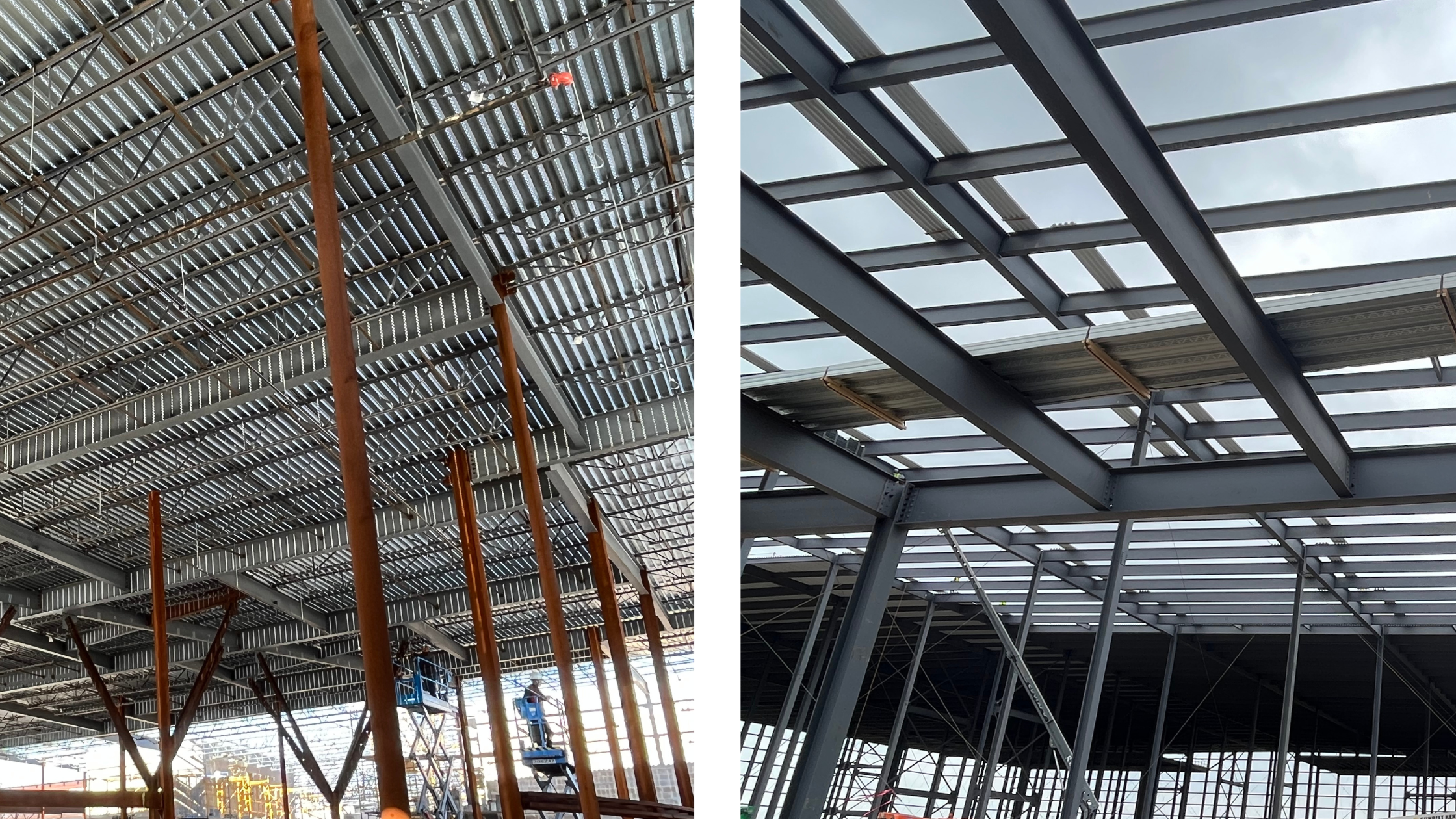
Steel beams (commonly wide-flange sections) are solid-web members used as primary framing (girders and columns) and sometimes as closely spaced secondary framing where depth, vibration, or special loading makes sense.
You’ll often use both in a building: beams and columns form the primary frame, while joists create efficient secondary framing for floors and roofs.
Design Considerations
From a design perspective, steel joists are highly efficient for long, repetitive spans. Their open-web configuration reduces weight while maintaining strength, making them particularly well-suited for roof systems and large floor plates. The open web also creates natural pathways for mechanical, electrical, and plumbing systems, which can reduce ceiling depth and simplify coordination.
However, joists are engineered components designed around specific loads and span conditions. When late design changes introduce new concentrated loads, large openings, or unusual support conditions, modifications can become more complex. In these cases, redesign or reinforcement may be required.
Steel beams, by contrast, offer greater flexibility in irregular framing conditions. They are often preferred in areas with heavy point loads, transfer conditions, or non-repetitive geometry. Because they are solid-web members, detailing around large openings or architectural features can sometimes be more straightforward. For vibration-sensitive occupancies such as offices or residential buildings, beams may also offer advantages in stiffness control, depending on span and depth.
Cost Implications
Cost comparisons between steel joists and steel beams depend on span length, loading requirements, and regional market conditions. In many long-span secondary framing applications, joists are more material-efficient. Their lighter weight can reduce overall steel tonnage, which often translates into material cost savings.
That said, joists are specialized products with fabrication schedules that can vary based on demand. Projects with tight timelines should confirm lead times early. Custom conditions—such as large penetrations or heavy mechanical loads—can also increase joist costs.
Steel beams are widely available and may offer procurement advantages in certain markets. However, because they are solid sections, they can require more steel to achieve similar spans. Higher tonnage may increase both material and transportation costs. As a result, many projects adopt a hybrid approach, using beams for primary framing and joists for efficient secondary framing.
Installation and Construction
Installation considerations can also influence the decision. Steel joists are generally lighter than comparable beams, which can make them easier to handle and potentially speed up erection. Once joists and bridging are properly installed, crews can move quickly to decking operations.
Proper sequencing is essential, however. Joists require bridging for stability, and erection procedures must follow established guidelines to ensure safety and structural integrity during construction.
Steel beams, while often heavier, follow familiar erection practices for many contractors. In frames where beams contribute significantly to overall stability, the erection sequence can be straightforward. Heavier picks and more robust connections may increase crane time, but beams can offer predictability in complex structural layouts.
Foundation Impact
The choice between joists and beams can also influence foundation design. Because joists are typically lighter, they can reduce the overall dead load on the structure. In some soil conditions, this reduction can result in smaller footings or fewer deep foundation elements.
However, long-span joist systems may concentrate reactions at joist girders or select columns. While total building weight may be lower, localized foundation demands may increase. Engineers must evaluate both total load and reaction distribution when comparing systems.
Steel beam systems may increase overall structural weight if heavier members are required, potentially leading to larger foundation elements. On the other hand, beam framing can distribute loads in a predictable, uniform manner across a regular column grid. Early coordination between structural and geotechnical teams is critical to understanding these trade-offs.
Sustainability and Material Efficiency
Both steel joists and steel beams benefit from steel’s recyclability and durability. Sustainability differences typically come down to material efficiency and long-term adaptability.
Joists often use less steel for long-span secondary framing, which can reduce embodied carbon associated with material production. Their efficiency can help reduce overall structural weight, enabling material optimization.
Steel beams, while sometimes heavier, may offer advantages in adaptability. Buildings frequently undergo renovations or tenant improvements over their lifespan. Solid-web beams can be easier to reinforce, modify, or accommodate new loads, which supports long-term building reuse and flexibility.
In many projects, sustainability goals align with selecting the most material-efficient system that still meets performance requirements and allows for future adaptability.
Making the Right Choice
For large, open-roof structures such as warehouses, retail spaces, or recreational facilities, steel joists are often a natural fit due to their span efficiency and lighter weight. In multi-story buildings, a combination of beams and joists is common. Beams typically form the primary structural skeleton, while joists provide efficient secondary support across repetitive bays.
Projects with irregular geometry, significant transfers, or heavy mechanical equipment zones may rely more heavily on beams. Conversely, buildings with regular layouts and coordinated MEP pathways often benefit from the efficiencies joists provide.
Ultimately, steel joists and steel beams are complementary systems rather than competing ones. Evaluating span length, load conditions, vibration criteria, foundation constraints, sustainability goals, and construction sequencing will help determine the most appropriate structural approach. Early collaboration between architects, structural engineers, and fabricators ensures the chosen system aligns with both design intent and project performance objectives.
Choosing Between Steel Joists and Steel Beams with Confidence
Steel joists and steel beams each play an important role in efficient structural design. Understanding steel joists vs steel beams allows architects and designers to balance span efficiency, cost, installation, foundation impact, and sustainability. The right solution is often a balanced approach that uses each system where it performs best.
If you need guidance comparing framing options or sourcing high-quality steel joists for your next project, contact us today. Our team can help you evaluate the right structural approach and keep your design moving forward with confidence.